
Queue Management System in Saudi Arabia: A 2026 Buyer’s Guide
Choosing the right queue management system in Saudi Arabia has become a boardroom decision, not an afterthought. As banks, hospitals, government service centers, and retail chains across Riyadh, Jeddah, and Dammam race to meet Vision 2030 service standards, the technology that governs how people wait, move, and get served is now a core part of the customer experience. In 2026, the smartest operators treat queuing as a data problem first and a hardware problem second.
This guide walks you through what a modern queuing platform actually does, how to evaluate vendors, and where drive-thru automation fits into the same conversation. Whether you run a single clinic or a national branch network, the principles below will help you buy once and buy right.
What Is a Queue Management System and Why Does It Matter?
A queue management system is the combination of software, displays, ticketing, and analytics that controls the flow of visitors from the moment they arrive to the moment they are served. Instead of a chaotic line, customers receive a ticket (physical or mobile), watch a live status board, and get called to a counter through audio and visual prompts.
The value is not the ticket. The value is the data trail. Every check-in, wait interval, service duration, and abandonment is logged. That telemetry lets managers staff smarter, cut idle time, and prove service-level compliance to regulators. In service-heavy sectors, shaving even ninety seconds off average wait can lift satisfaction scores measurably.
Reliable deployment matters as much as features. Partnering with dependable specialists who understand both the software and the on-site networking wiring will save you months of troubleshooting after go-live.
Core Features to Demand in 2026
Feature checklists have grown longer as expectations rise. A credible platform in 2026 should ship with the essentials below, not sell them as costly add-ons months later.
- Mobile and virtual queuing: Customers join from a smartphone and arrive only when their turn is near.
- Appointment booking: Pre-scheduled slots blend with walk-ins on one dashboard.
- Multilingual displays: Arabic and English at minimum, with right-to-left rendering done properly.
- Real-time analytics: Live wait times, counter productivity, and peak-hour heat maps.
- Feedback capture: A quick rating prompt at the end of each interaction.
- Integration APIs: Clean hooks into CRM, ERP, and identity systems.
How Do You Compare Vendors Fairly?
Vendor demos are polished by design. To cut through the gloss, score every candidate against the same weighted criteria. The table below is a practical scoring frame our consultants use during procurement reviews.
| Evaluation Area | What to Verify | Weight |
|---|---|---|
| Local support | On-site engineers in-Kingdom, SLA response times | High |
| Scalability | Multi-branch central management, cloud option | High |
| Integration | Open APIs, existing CRM and ERP connectors | Medium |
| Analytics depth | Custom reports, exportable data, live dashboards | High |
| Total cost | Licensing, hardware, maintenance over 3 years | Medium |
Insist on a reference site you can visit in person. A vendor confident in their deployment will happily arrange a walkthrough at a live client branch in Riyadh or Jeddah.
Where Do Drive-Thru Solutions Fit In?
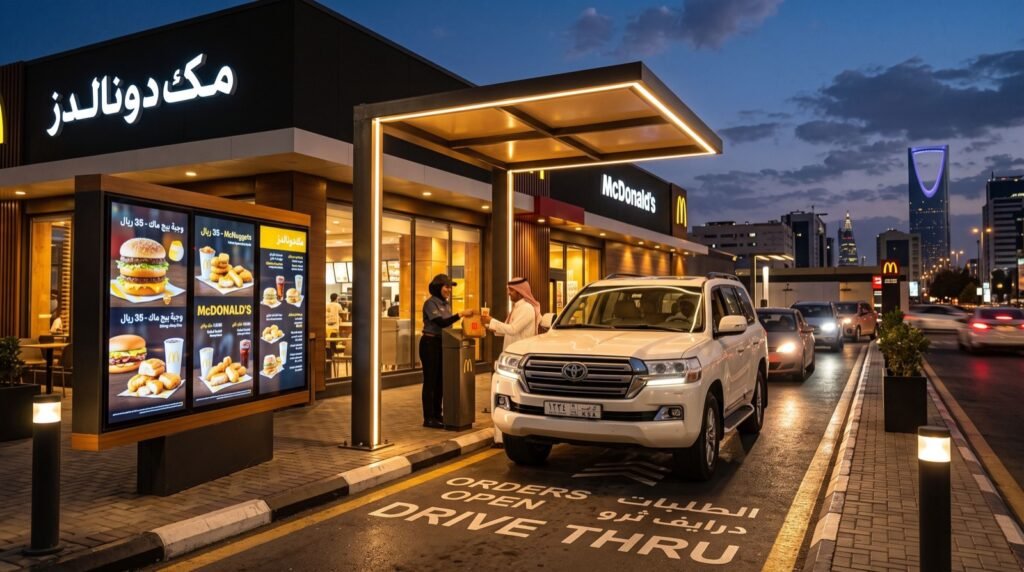
Queuing is not limited to indoor counters. Quick-service restaurants and pharmacies increasingly compete on lane speed. Modern HME Drive Thru in Riyadh deployments use the same philosophy as counter queuing: measure every second, remove friction, and give staff live visibility into lane performance.
Integrating drive-thru timing systems with your broader queue management system in saudi arabia gives leadership one unified view of throughput across every channel. That single pane of glass is what separates a tidy line from a genuinely optimized operation.
The Networking Layer Nobody Talks About
Behind every smooth queuing display sits structured cabling, PoE switches, and resilient Wi-Fi. Under-specified networks are the number one cause of laggy displays and dropped tickets. Budget for the infrastructure, not just the software license, and your rollout will age gracefully.
Implementation: A Phased Rollout That Works
Big-bang launches across dozens of branches rarely end well. A phased approach de-risks the investment and builds internal champions along the way.
- Pilot: Deploy at one flagship branch and stress-test during peak hours.
- Measure: Collect two to four weeks of baseline data.
- Refine: Adjust counter logic, signage, and staffing rules.
- Scale: Roll out to remaining branches with a proven template.
- Optimize: Review analytics monthly and tune continuously.
According to the Saudi Vision 2030 government portal, elevating the quality and efficiency of public and private services is a national priority, which is precisely why data-driven queuing has moved from luxury to expectation across the Kingdom.
Measuring Return on Investment
Executives rightly ask what a queuing platform returns. The honest answer is that value shows up in several places at once, some obvious and some easy to overlook. Framing the business case around all of them makes approval far easier.
Direct savings come from smarter staffing. When analytics reveal exactly when peaks hit, managers stop over-staffing quiet hours and under-staffing rushes. That single adjustment often pays for the system within the first year.
The softer returns are just as real. Shorter, calmer waits lift satisfaction scores, reduce complaints, and improve staff morale because employees face fewer frustrated customers. Over time, that reputation advantage compounds into loyalty and repeat visits.
There is also a compliance dividend. In regulated sectors, being able to prove average wait times and service levels with exportable reports protects the organization during audits and inspections. Data that once lived only in anecdotes becomes defensible evidence.
A practical tip from live deployments: agree on three or four headline metrics before go-live, such as average wait, average service time, and abandonment rate. Baseline them, then review monthly. Without a baseline, you can never prove the improvement, and the investment looks invisible even when it is working hard.
Frequently Asked Questions
How much does a queue management system in Saudi Arabia cost?
Pricing depends on branch count, counter numbers, and whether you choose cloud or on-premise. A single-branch setup can start modestly, while enterprise multi-site deployments are quoted per counter with annual support. Always compare a three-year total cost, not just the upfront license.
Can a queuing system integrate with our existing CRM?
Yes. Any credible 2026 platform exposes REST APIs and pre-built connectors for common CRM and ERP systems, so customer identity and history flow into the service counter automatically.
Does virtual queuing really reduce physical crowding?
It does. When customers join remotely and arrive close to their turn, lobby congestion drops sharply, which is valuable for hospitals and government centers managing large daily footfall.
How long does implementation take?
A single-branch pilot can go live within two to four weeks. Multi-branch rollouts follow the phased model above and typically span a few months depending on network readiness.
Final Thoughts
The right queue management system in Saudi Arabia does far more than issue tickets. It turns waiting into measurable, improvable data and unifies counter service with drive-thru lanes under one intelligent roof. Prioritize local support, open integration, and deep analytics, run a disciplined pilot, and insist on solid networking underneath. Do that, and your 2026 investment will keep paying dividends long after go-live. Ready to modernize? Talk to a specialist and book a live demo today.